
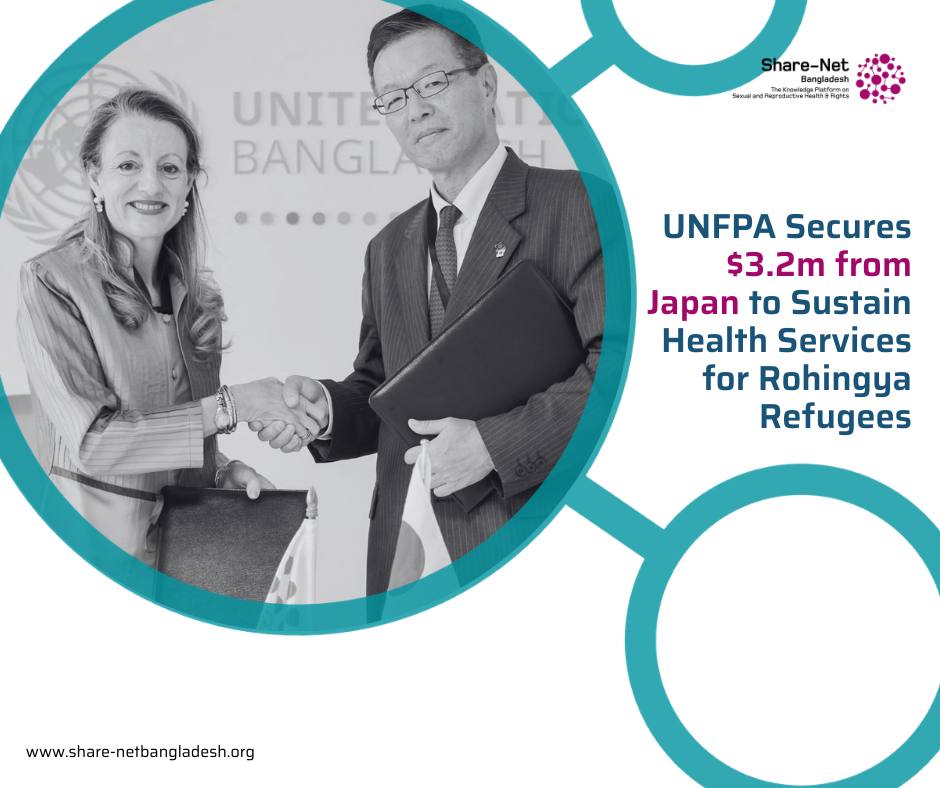
UNFPA Secures $3.2m from Japan to Sustain Health Services for Rohingya Refugees in Bangladesh
When humanitarian funding shrinks, it is often women and girls who feel the first and deepest cuts. In the crowded camps of Cox’s Bazar and on the remote island of Bhasan Char, access to sexual and reproductive health and rights (SRHR) services can mean the difference between life and death. Against this backdrop, Japan’s latest pledge of $3.2 million offers not just financial support—but a vital pause in an unfolding crisis.
The Government of Japan has approved JPY 500 million (approximately $3.2 million) to the United Nations Population Fund (UNFPA) to continue essential sexual and reproductive health care and gender-based violence (GBV) services for Rohingya refugees and surrounding host communities.
Ambassador Saida Shinichi reaffirmed Japan’s position, saying, “Japan remains firmly committed to protecting the most vulnerable, particularly women and adolescents affected by displacement.” His words come at a time when the 2025–2026 Joint Response Plan for the Rohingya Humanitarian Crisis is significantly underfunded.
The scale of need remains staggering. Cox’s Bazar hosts over one million Rohingya refugees, alongside vulnerable Bangladeshi host communities. Since 2024, an estimated 150,000 new arrivals—more than half women and girls—have added pressure to already overstretched services. Funding shortfalls have led to the closure of six government-run health facilities, a 16% reduction in the midwifery workforce, and over a 50% cut in GBV case managers.
This is where Japan’s contribution becomes critical. The funding will help UNFPA maintain 24/7 emergency obstetric care, GBV case management, and mental health support for approximately 180,000 direct beneficiaries. In a humanitarian setting, uninterrupted emergency obstetric care alone can drastically reduce maternal deaths and prevent life-threatening complications.
Catherine Breen Kamkong, UNFPA Representative in Bangladesh, described the funding as “a vital lifeline,” noting that it would “sustain life-saving services that protect the health and dignity of women and adolescents who would otherwise face devastating gaps in care.”
The new two-year phase builds on tangible results. More than 38,000 women and girls have already accessed essential services at UNFPA-supported facilities in Cox’s Bazar and Bhasan Char. Japan’s earlier support also helped operationalise a 20-bed hospital in Bhasan Char, significantly reducing emergency referrals and maintaining low maternal mortality rates.
Beyond clinical care, the partnership has expanded survivor-centred GBV services through Women Friendly Spaces and Women-Led Community Centres—an approach increasingly recognised as a best practice in humanitarian SRHR programming. These spaces offer not only medical support but also psychosocial counselling, legal referrals, and safe community engagement.
From an SRHR movement perspective, the funding is a positive signal in an otherwise tightening global aid climate. It highlights a shift from short-term emergency response to sustaining systems—midwives, case managers, adolescent empowerment initiatives—that address both immediate survival and long-term prevention of gender-based violence.
However, one country’s support cannot close the widening funding gap alone. Since 2017, Japan has contributed over $250 million to the Rohingya response, making it one of the most consistent partners. Yet humanitarian actors warn that without broader international solidarity, gains in maternal health, adolescent empowerment, and GBV prevention could unravel.
In a crisis that has stretched nearly a decade, sustaining SRHR services is not merely about healthcare—it is about dignity, agency, and rights. Japan’s $3.2 million may not solve the funding crisis, but for thousands of Rohingya women and girls, it keeps hope—and essential care—within reach.
Source: The Business Standard
